The Mountain Unearthed: Uncanny Geological Futures in a Mongolian Mining Town
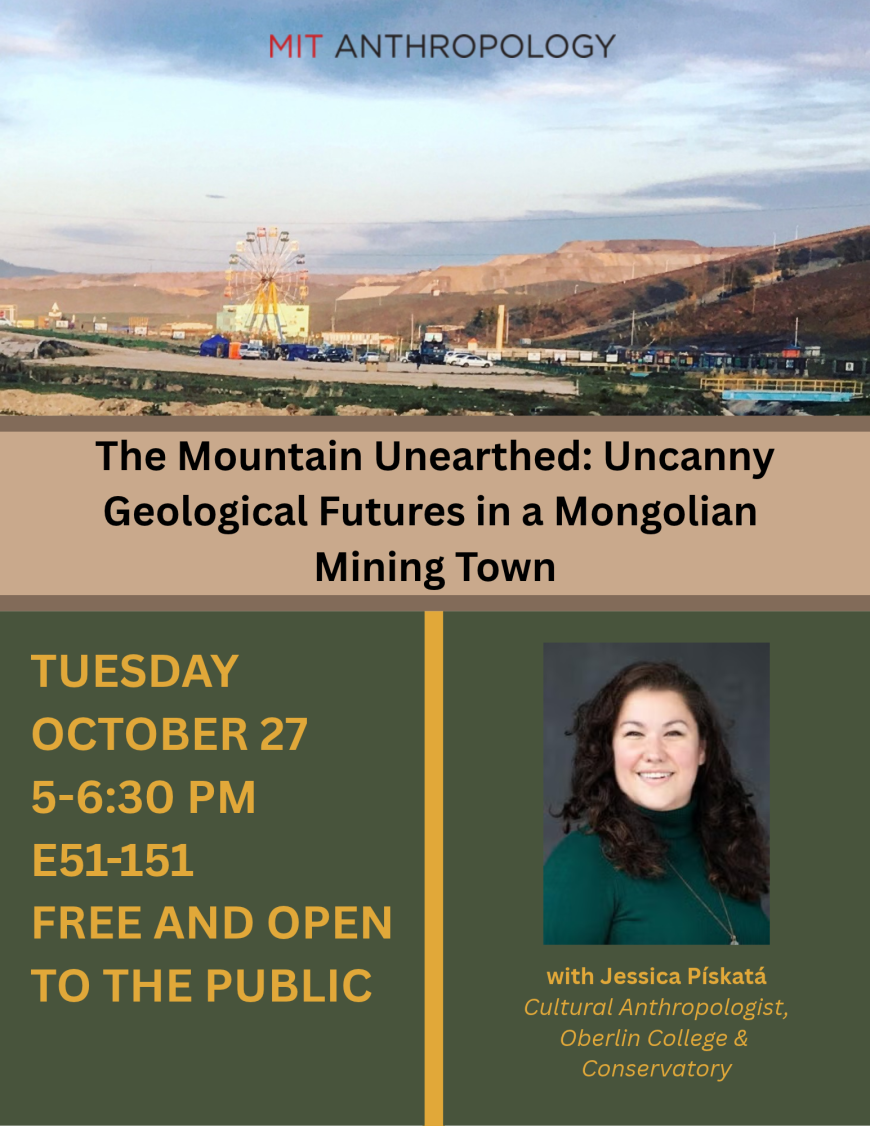
Jessica Pískatá, Cultural Anthropology Lecturer
Oberlin College & Conservatory
Tuesday, October 27
5 to 6:30 pm
E51-095
The Mountain Unearthed: Uncanny Geological Futures in a Mongolian Mining Town
Geological futures engage a timescale which is both beyond the scope of human life and, in Mongolia, intensely engaged in the present everyday of those who are living. This paper draws on the concept of the uncanny, which has been used by theorists of climate change (Ghosh 2019) and the more-than-human (Fernando 2022) to grapple with that which is likewise untranslatable or unfathomable in scale. Here, I return to its use as a domestic horror aesthetic (Freud 1919) in order to analyze a critical description of two monstrous forms from Mongolia’s mineral extraction boom: the spoil heap and the leach mine. Using the uncanny in this way allows us to engage with the ambivalent ecological horrors of mineral extraction, which are both eldritch in scope and deeply intimate.
About Jessica Pískatá
Jessica Madison Pískatá is a cultural anthropologist whose research focuses on the relationships between humans and geological landscapes on the peripheries of Cold War empires. Her work looks at the intersection of poetic practice and geological sociality on the Dariganga Volcanic Field in eastern Mongolia. She is currently working on a new project that explores the contemporary and historical resonances at uranium extraction sites in Mongolia and the Czech Republic (Czechia). Pískatá holds an MFA in poetry at the New School and a PhD in cultural anthropology at the University of California at Santa Cruz.
