
Congratulations to our winners for the 2026 James Howe Prize!
Angela Jiao wrote “Challenging the Model Minority Myth through my Mother’s Life Story” for 21A.144 Asian American Experiences: Anthropological Perspectives in Spring 2026. Angela is a fourth-year student majoring in Biological Engineering (Course 20). Most contemporary Asian immigrants’ journeys are often represented in a compressed way—either as stories of success or as tales of struggle against poverty and racism. Such portrayals misrepresent the centuries of complex and diverse Chinese migratory experiences. Some newer immigrants, especially from the late twentieth century onward, often subscribe to the Model Minority Myth without fully understanding its historical origins and the earlier immigrants' long struggles against racism. Through interviews with her mother, as well as through autoethnography, the author uncovers many “human” dimensions of these experiences. The paper complicates and deepens our understanding of immigrant experience and explores why, despite the many negative influences that stem from the Model Minority Myth, her parents and many of her parents’ generation still finds partial refuge in this loaded concept.
Mariia Maliar wrote “Flowers on the Wall, Roots in the Village: The Cultural Life of Petrykivka Painting” for 21A.00 Introduction to Anthropology: Comparing Human Cultures in Fall 2025. Mariia is a first-year student majoring in Mechanical Engineering (Course 2). This paper explores the author’s home village of Petrikivka in war-torn Ukraine and the unique art form—also called Petrikivka painting—that originated there. Engaging in this art form has served not only as a means of sustaining life after the collapse of socialism and during the war, but also as a way for people to unite in exile outside Ukraine. The author examines the contestations over authenticity and authorship among villagers and artists as the art has become globalized and adopted by international artists and amateurs. Similar to wine, cheese, and other regionally rooted products, local artists claim authenticity based on a broader notion of culture—one tied to place, lived experience, cultural memory, and a sense of cultural responsibility—beyond the mere mechanical practice of mastering artistic techniques.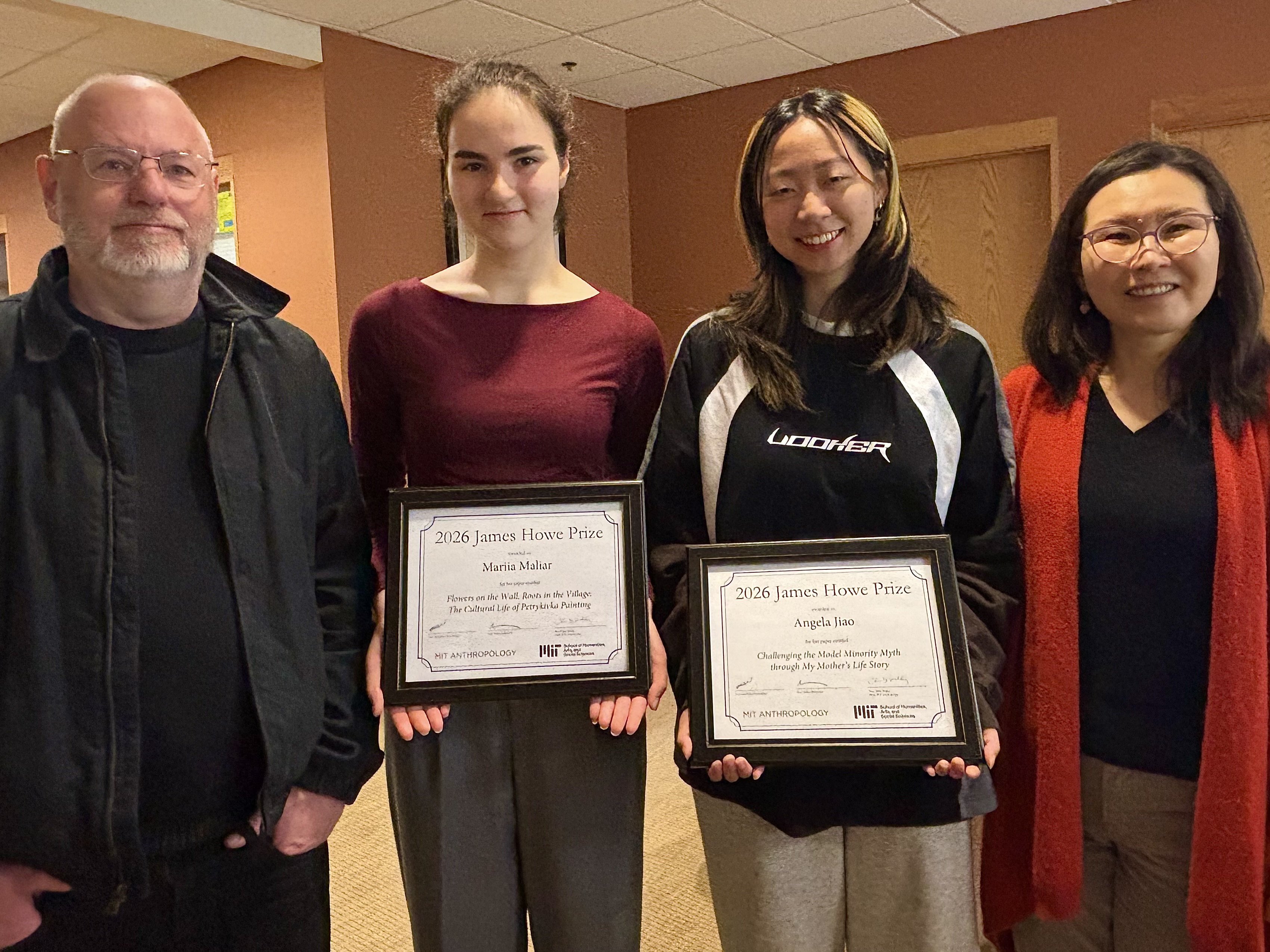
MIT Anthropology announces the 2026 James Howe Prize!
Deadline: 5pm April 3rd
We seek submissions from current MIT undergraduate students on any topic submitted for coursework in MIT Anthropology. Submissions will be evaluated on their originality, scholarly content, and the effectiveness of their writing or presentation. A faculty committee will judge entries. Students should submit work to jhprize@mit.edu.
One or more winners will each receive a $300 award. They will be announced on or before April 24, 2026 and will be featured on the MIT Anthropology website.
About the James Howe Prize:
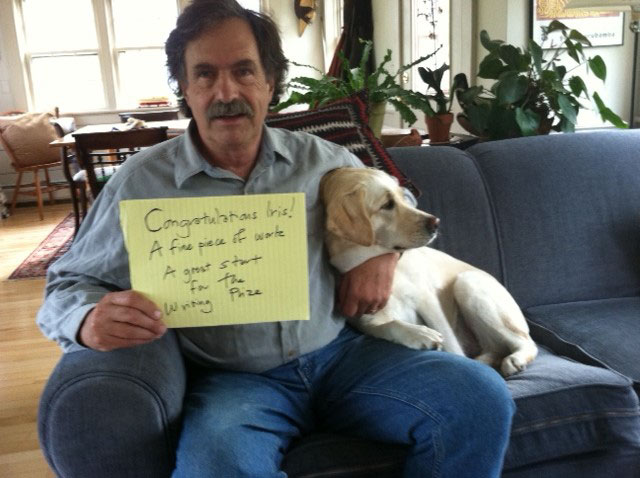
The annual James Howe Prize honors the contributions of Professor of Anthropology James Howe, who retired in 2012. Howe's scholarship has focused on the history and political struggles of the indigenous Kuna population in Panama. He has also promoted human rights throughout his distinguished career. A renowned photographer and political activist, Howe has undertaken ethnographic work to support the rights of the Kuna people.
He is also a longstanding board member of Cultural Survival—an organization that provides support to and advocates on behalf of the linguistic, cultural, and property rights of indigenous populations around the world.
Guidelines for Submission:
Current MIT undergraduates or cross-listed students from Harvard or Wellesley may submit multiple entries. The topic is open.
Since remote teaching started in Spring 2020, some instructors have substituted other media projects for term papers. To reflect the diversity of formats in which students have explored Anthropology topics, we continue to accept Howe Prize submissions in the form of podcasts, short videos, websites, photo stories, and other media, in addition to papers.
Eligible papers must have been written for MIT Anthropology classes or as part of an undergraduate anthropology thesis (i.e., a thesis chapter). They may be revisions of essays written and graded for MIT Anthropology subjects. They should be at least 10 double-spaced pages in length but must not exceed 25 pages.
Other media works should be of comparable size and scope. If in doubt, go ahead and submit!
Works that have been previously published are not eligible.
Submissions must include a title, as well as a consistent and thorough citation style and bibliography. The student’s name should not appear anywhere on the paper or in the media file. Please be sure to indicate on your cover sheet whether you used AI or LLMs (large language models) in researching, writing, and/or editing your paper or project; and if so, how.
*****************
Each entry should be submitted with a cover sheet that includes:
- Student name
- Submission title
- Anthropology subject for which the submission was produced
- A description of whether and how you used AI or LLMs (large language models) in researching, writing, and/or editing your paper or project
- Major
- Expected year of graduation
- Email address
- Phone number
- MIT Student ID number
Please submit entries and cover sheets to jhprize@mit.edu.
Please address questions to jhprize@mit.edu.
PAST WINNERS:
2025: Viviana Cardenas-Hasbell, Shruthi Ravichandran, Daniel Antov
2024: Ella Trumper, Cindy Xie, and Leon Hernandez
2023: Negin Amouei, Cindy Xie
2022: Jaclyn Thi, Alexandra Poret
2021: Luísa Apolaya Torres, Lia Hsu-Rodriguez, and Varsha Sridhar
2020: Elena Andree and Marissa McPhillips
2019: Maryam Pervaiz and Leanne Wang
2018: Jackie Liu and Gabriella Zak
2017: Ankita Reddy and Haley Strouf
2016: Paige Omura
2015: Andrei Kilshin and Peter Haine
2014: Sofia Essayan-Perez
2013: Iris Sheu